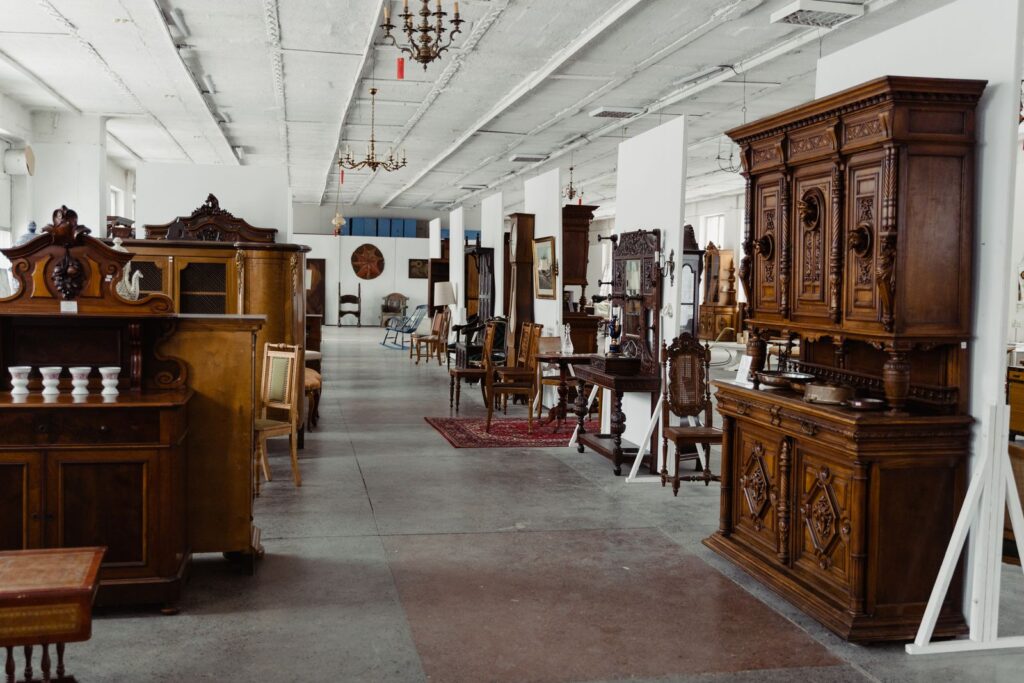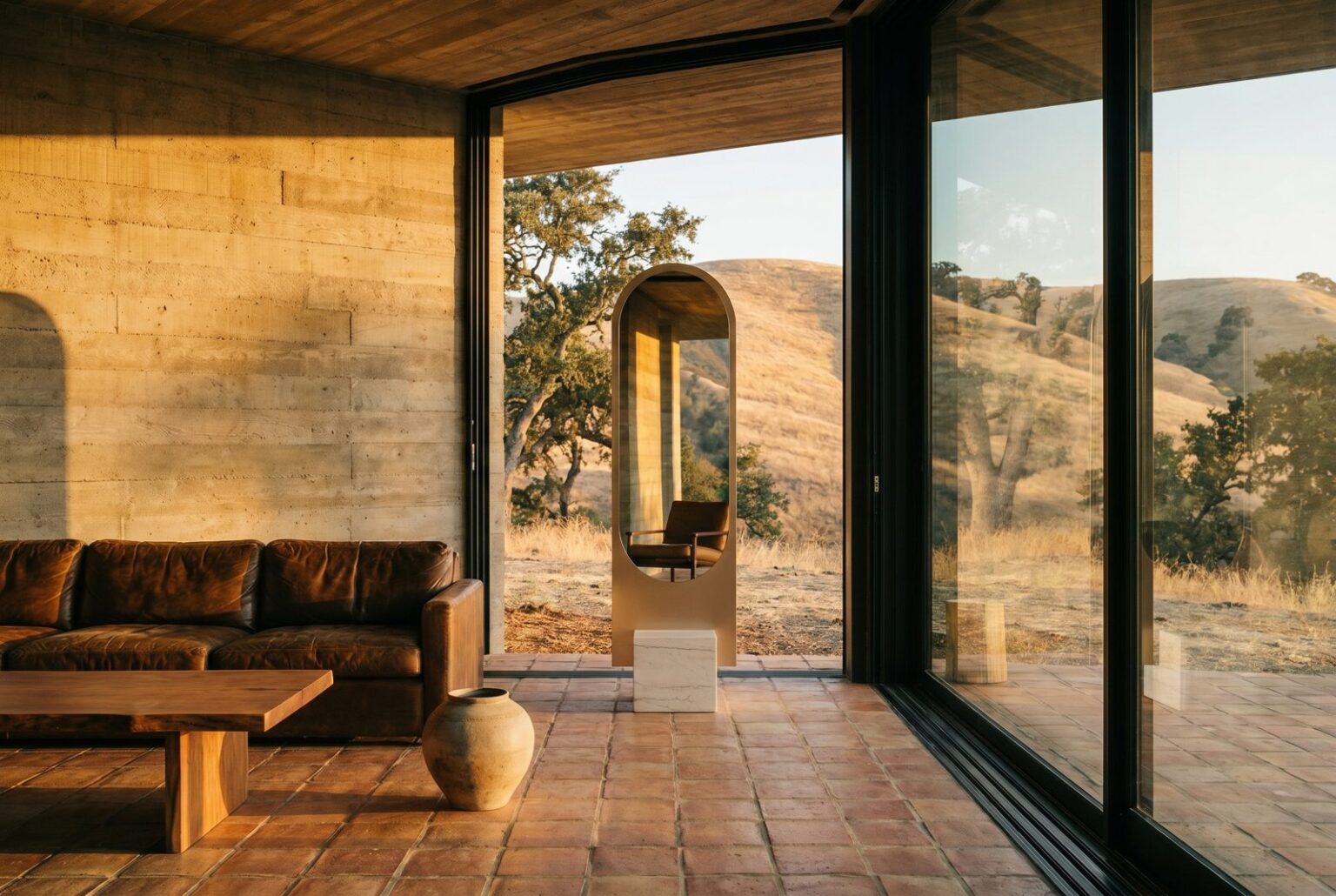
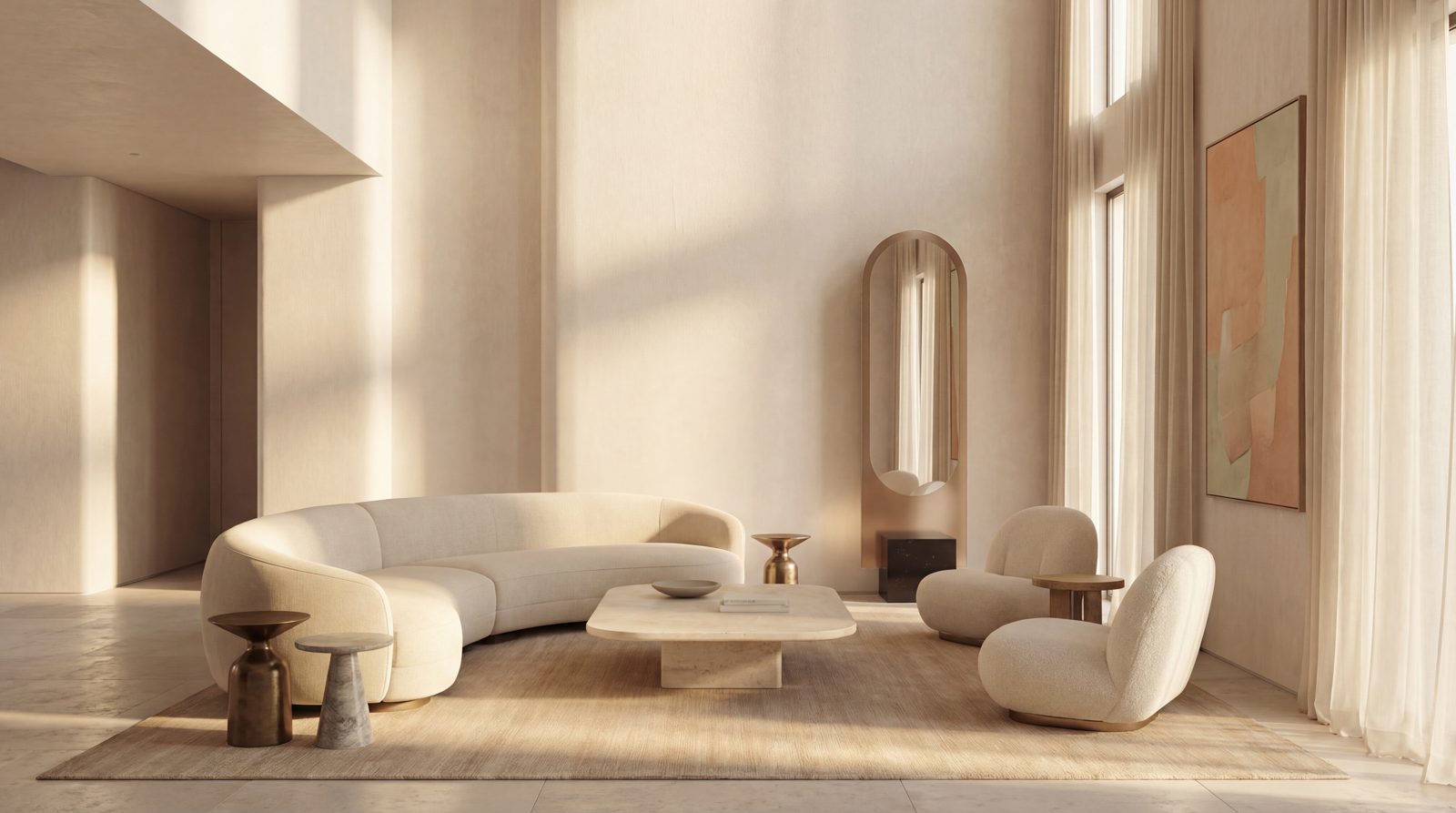
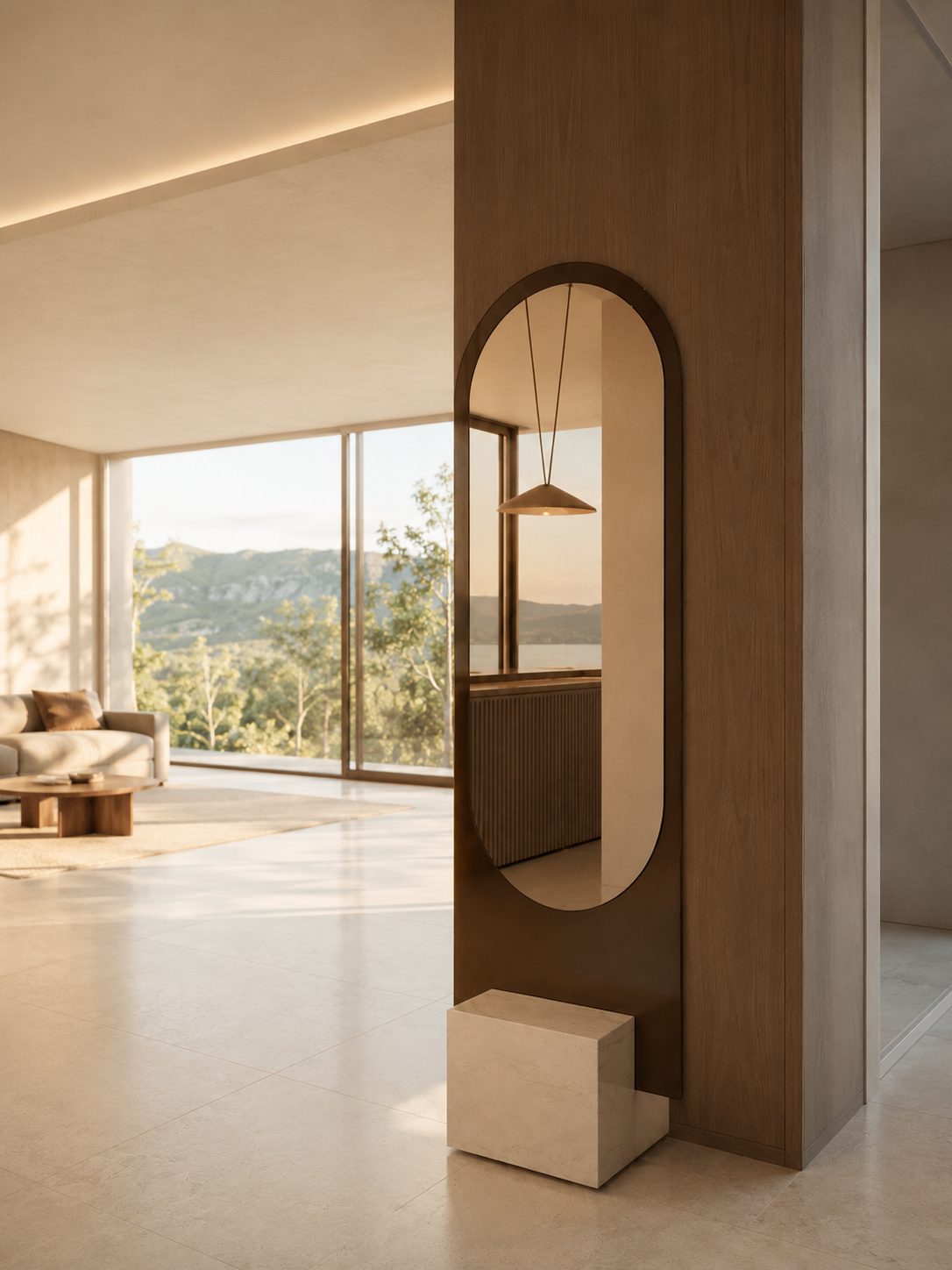
Some objects announce themselves before you understand why. The Alice piece by Toronto studio Claris Company is one of them: a freestanding floor sculpture of bronze-frosted Belgian glass rising from a base of mineral surface, catching the room and holding it. Call it a statement mirror if you like, but the word undersells what is happening. This is glass and stone asked to share a single form, and to do it without either one winning.
Alice arrived through a collaboration between Claris and Cosentino, the surface company whose ĒCLOS material anchors the base. Cosentino tells the origin story in its own words, and it is worth reading for anyone who cares about how material choices actually get made. For an LA audience raised on indoor-outdoor living and the sculptural object placed just so, the piece is a useful case study in composition, weight, and the way a surface behaves when the light keeps changing on it.
A statement mirror that reads as sculpture
Most mirrors solve one problem: they reflect. Alice was drawn to do more. It stands on the floor, so you meet it the way you meet a chair or a lamp or a piece of art, not the way you meet something bolted to a wall. The bronze-frosted glass softens what it returns, so the reflection reads as atmosphere rather than a straight report. And the ĒCLOS base gives the whole thing a center of gravity, a reason to stay put.
That combination is what pushes a statement mirror out of the bathroom and into the living room, the entry, the corner of a bedroom that needed something with presence. Claris designed a smaller companion too, Alice Mini, scaled for a countertop, a shelf, or a vanity. Both come in two finishes: ĒCLOS Ivora, a warm off-white matte, and Phantome, a deep matte black. The material stays the same. Only the mood shifts.
The material question: ĒCLOS as a full-body surface
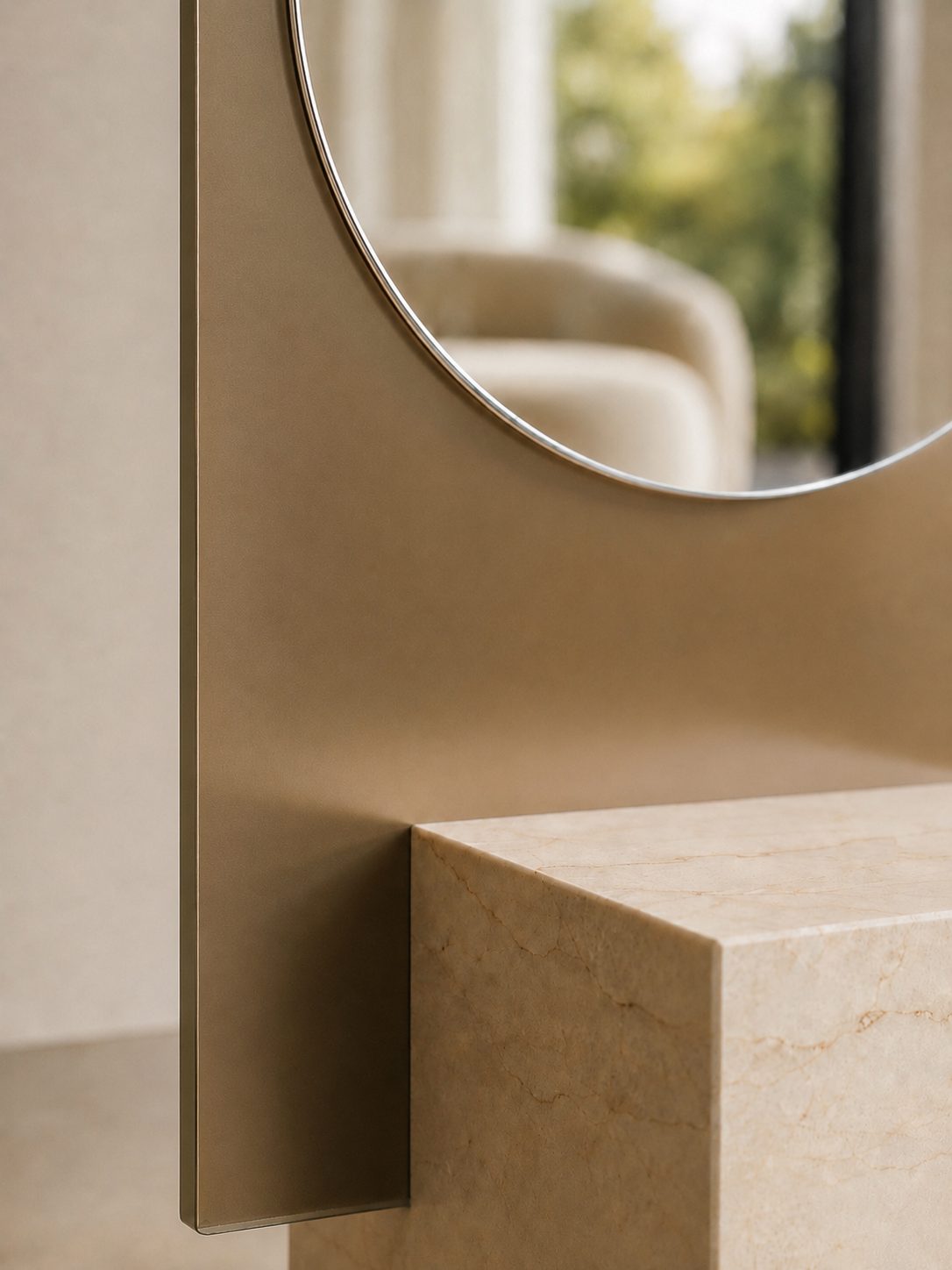
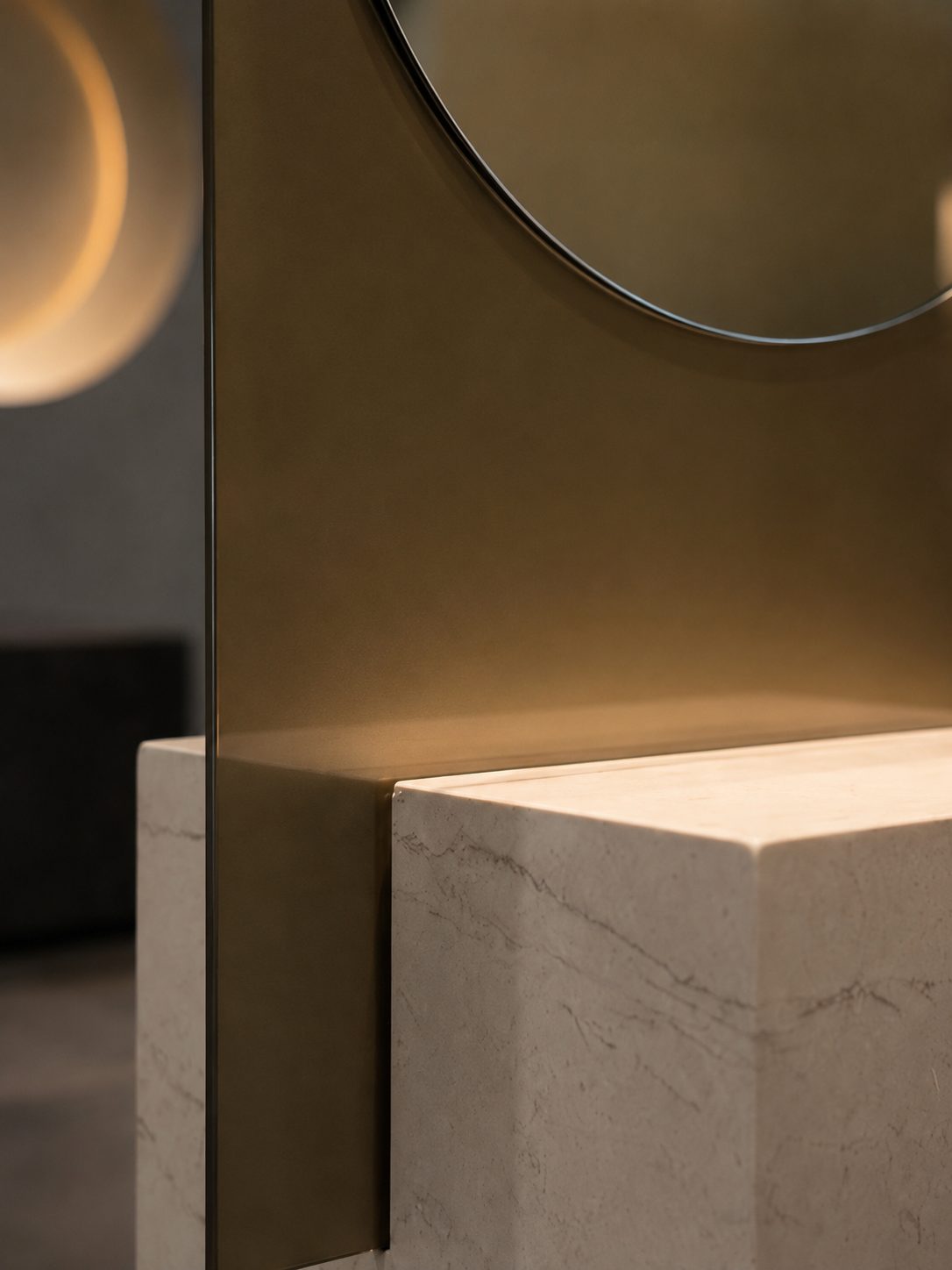
Cosentino describes ĒCLOS as a full-body mineral surface with continuous veining, developed for architecture. The phrase “full-body” is the part that matters here. The same natural character runs through every edge and profile, so the material can be shaped and exposed from any angle without losing its visual integrity. Cut it, turn it, stand it on end, and it still reads as one continuous piece of stone rather than a thin skin over a core.
For a floor sculpture, that property is not a nice-to-have. A base that shows its cut faces to the room has nowhere to hide. Cosentino frames ĒCLOS as denser and more considered than typical surfaces, and the density is what lets Alice keep its composure from every side. There is no back of the piece, in the sense that every angle is finished, veined, and intentional.
Glass and stone, in conversation
Alice came out of a working relationship, not a brief. Per Cosentino’s account, Claris founder Eugene Ishchak met designer Benoit Gerard at Cosentino’s C·NEXT event. The dialogue continued at Cosentino City Toronto around “Twins,” an earlier mirror concept that became the creative language of Gerard’s Gemini Collection. At C·NEXT 2026, the two encountered ĒCLOS, and the material found its object.
The idea was never simply to create another mirror. It was to create an object where every material contributes equally to the overall composition.
That principle is the whole design. In the collaboration, ĒCLOS anchors each mirror structurally and visually, balancing the transparency of Belgian glass against the weight, texture, and permanence of the mineral surface. Neither material dominates. The glass gives you air and reflection; the stone gives you mass and stillness. Read together, they hold a kind of tension that a single material could not produce on its own. This is the part LA designers tend to respond to: a piece that earns its place because it does two things at once.
How the light moves through it
LA light is a co-author in any interior here. It comes in low and gold at the end of the day, floods rooms at noon, and rakes across every surface as the sun crosses the sky. Alice was built for exactly that condition. Cosentino notes that the experience of the piece changes as light, movement, and perspective shift through the day. The bronze-frosted glass takes on the color of the room and the hour; the matte ĒCLOS base absorbs and holds rather than bounces, so it never turns into a bright spot fighting the window.
The result is an object that is never quite the same twice. Morning gives you one Alice, dusk gives you another. If you have thought carefully about how a room reads at different hours, the way we broke down in our comparison of Hollywood mirrors versus backlit mirrors, you already understand why that matters. A mirror is a light instrument as much as a reflective one, and Alice treats it that way.
Where it lands in an LA interior
Think about where a floor sculpture wants to live. Not pinned above a sink, but standing where a piece of art would stand: at the turn of a hallway, beside a window, in the open plan where inside meets patio. The stone-and-glass composition suits the hillside modernism that runs through neighborhoods like Silver Lake, where glass walls and considered objects have been in dialogue since the Neutra years. We traced that lineage in our look at Silver Lake interior design, and Alice would sit comfortably inside it.
The same logic applies to the hospitality rooms that set the tone for how LA lives. The lobbies and restaurants we studied in the city’s most instructive interiors lean on a few strong objects doing a lot of work. A stone-based mirror that reads as sculpture is precisely that kind of object: one piece that carries a corner, gives the eye something to land on, and rewards a second look as the light turns. Alice Mini does the same job at close range, on a vanity or a shelf, where the veining and the frosted glass are read from inches away rather than across a room.
The collection behind the object
Alice belongs to Claris’s Gemini Collection, nine mirrors by Benoit Gerard that each pair a primary form with a circular aperture. All nine use 6mm Bronze Frosted Belgian glass, crafted in Europe, drawn from Diamond ClearVision low-iron stock, certified to North American standards and backed by a five-year warranty. Low-iron glass matters for the reason it always does: no green cast, so color and finish come back the way the room intends them.
The range spans a working set of price points. Alice Mini opens the collection at $750, with the tabletop piece made for countertops and shelving. Gigi starts at $1,350, Alhena at $1,700, Twins at $1,800, Leda at $1,900, Jumeau at $2,000, Mercure at $2,400, and Vivo at $2,550. The floor sculpture, Alice itself, sits at the top at $5,000, which reads as fair for a full-body ĒCLOS base married to hand-finished glass. For a smaller anchor piece, Alhena and Leda carry the same glass and the same aperture logic at a lower entry.
What makes the collaboration worth watching is not the price list, though. It is the argument the object makes: that a mirror can be a composition of equal materials, that stone and glass can share a form without one apologizing for the other, and that the piece keeps changing as the LA day moves across it. That is a statement mirror doing more than its job description. It is a design object, and it behaves like one.
Sources
- Cosentino, How ĒCLOS Became an Integral Part of Alice and Alice Mini
- Claris Company, Gemini Collection